
Send this article to a friend:
December
05
2025
|
Send this article to a friend: December |
Why Are Central Banks Escalating Their Gold Buying?
Gold’s December performance comes with a warning labelAccording to CNBC, gold has been inching higher, trading back around $4,130 as markets price in an 85% likelihood of a December interest-rate cut. On the surface, this looks routine – rate cut speculation pushes gold up. But zoom out, and the picture becomes more interesting. This year, gold reached an all‑time high of $4,380 with only two rate cuts. Historically, deeper cutting cycles are far more inflationary. If gold can hit record levels before easing even begins in earnest, we should ask what happens once the full cutting cycle is underway. For years, I’ve argued that gold tends to rise even during rate‑hiking cycles – contrary to popular belief. But the really dramatic moves happen when two things overlap:
Both appear to be forming now. Jobs data keeps getting revised lower. Retail sales – hailed as “strong” for months – fell in September despite supposedly tame inflation. Meanwhile, everyday Americans are telling a very different story in grocery aisles and gas stations. Rates are likely heading much lower. And when policy shifts from “tightening” to “stimulus,” the dollar tends to weaken quickly. That's not good news when we consider that the dollar has already fallen nearly 9% year-to-date… Here's the bottom line: If the Fed cuts aggressively in 2026, it will debase the dollar faster than prior cycles simply because we’re starting from a much weaker position – high government debt, soft consumer demand, and an economy that’s losing momentum. That’s why many mainstream forecasts calling for $5,000–$6,000 gold aren’t outliers – they’re consistent with what gold has done in comparable periods of monetary easing. Silver’s breakout could be a canary in the coal mineBloomberg reported that silver surged to a fresh record high, despite gold still sitting $200 below its own all‑time high. Silver often lags gold during the early stages of a run – but it tends to sprint ahead when the financial system shows real strain, such as when deficits surge, supply shortages deepen, or confidence in risk assets starts to wobble. For months, I’ve said that the real tell – the moment the market admits silver has been artificially cheap – would be a silver breakout without a corresponding gold spike. We’re seeing the early shape of that pattern now. Despite what you may have seen in the news, silver isn’t rising because inventory dipped in one region or because of a London squeeze. Those stories make for tidy soundbites, but they miss the fundamental reality:
That combination doesn’t produce gentle price adjustments. It produces an abrupt re‑pricing. We’re not there yet – silver is still vulnerable to volatility around $60–$70. But the fact that silver is breaking new ground while gold stays range‑bound suggests a deeper system imbalance. Silver is behaving like a pressure valve in a market that has been tightly held down for years. When structural deficits collide with rising investor interest, the result is rarely calm. Keep a close eye on silver in the coming weeks – it may tell us more about market stress than gold does. Global trust in the dollar is declining – here’s proof I’ve always been concerned that, when Russia’s funds were seized back in 2022, certainly it was a blow to the nation. However, I’ve argued long and loud that this unprecedented act was a far greater blow to the reputation of the U.S. dollar as a safe haven. (This is also the premise of Bloomberg reporter Saleha Mohsin’s excellent book Paper Soldiers.) How far can the U.S. push weaponization of the dollar before the rest of the world, friends and rivals alike, start to see the dollar as a liability rather than an asset? Well, things have gone a step farther. According to Reuters, Russia’s central bank recently claimed that central banks are accelerating gold purchases not only because reserves were frozen – but because G7 nations may actually spend that money. There’s a big difference between “freezing” and outright seizure… And as Matt Levine wrote way back in March 2022, when the U.S. actually exercises its control over the dollar-based financial system, it increases the likelihood that the system will be replaced. “The system is weakened each time it exercises its power.” So the Russian central bank is pointing to two facts – the seizure of their dollars, and the huge increase in central bank gold buying – and telling us to connect the dots. I think they have a good point – whether or not you agree, this claim raises an important point. Here's what I think is the real message: Central banks don’t need to agree with Russia to take the message seriously. For decades, the global financial system ran on a simple premise: Reserves held abroad were safe. The “safe-haven” U.S. dollar was, in fact, a safe haven. But once the West froze Russian assets, that assumption cracked – I fear permanently. Today, even the possibility of asset freezing or seizing is enough to change the behaviors of central bankers worldwide. Now you understand why central bank gold buying has exceeded 1,000 tons per year – a record streak – three years in a row (2022–2024). 2022 was, in fact, the single biggest year for central bank gold buying in history. Personally, I have trouble visualizing what 1,000 tons of gold really means. In case it’s a struggle for you too, here’s a more relatable way to picture it. Each year, central banks have been buying the equivalent of:
When you translate abstract numbers like "tons" into objects you can actually hold in your hand, the scale becomes clearer. And it's pretty shocking! Consider also that global central banks already own one of every six ounces of gold on earth – but that’s not enough. They still want more. But here’s the twist most of us just don’t want to hear: Everyday Americans are far more exposed to U.S. policy shifts than foreign central banks are. If a central bank wants safety, it can shift billions into gold with a single policy directive. My family, by contrast, is stuck living inside the dollar-based financial system. When the dollar weakens or inflation stays sticky, we feel it instantly – at the grocery store, the gas pump and most of all in our savings. If the world’s most powerful monetary institutions are questioning the safety of IOUs and debt-based assets (like currencies) while increasing their gold reserves, the message isn’t subtle. Trust itself is becoming a scarce commodity. Debt-based assets like currencies and government debt can only be considered assets so long as we can trust the issuer. Without trust, what really has value? When trust is discounted, assets that don’t rely on trust, like physical gold and silver, go through a great repricing. See, I believe that the surge we’ve seen in gold and silver prices isn’t so much that gold and silver are going up. Rather that gold and silver are being repriced as “trustless” assets, completely without counterparty risk. In times like these, physical precious metals become less of an asset choice and more of a financial seatbelt. If you’d like to learn more about diversifying your savings with physical precious metals, you can request a free information kit right here on this page.
|
Send this article to a friend:
 |
 |
 |
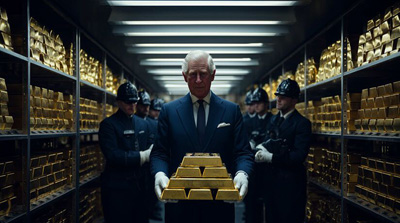 Gold is creeping higher with almost no fanfare, silver is surging to fresh records, and even Russia is warning that G7 nations may seize foreign reserves. Beneath the headlines is a simple reality: trust in global finance is eroding, and physical precious metals are quietly becoming the preferred safe harbor…